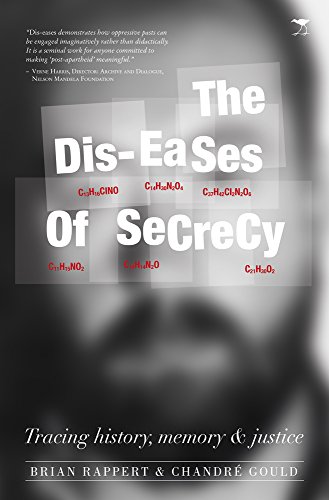
The dis-eases of secrecy : tracing history, memory and justice / Brian Rappert & Chandré Gould.
Material type: TextLanguage: English Publisher: Auckland Park, South Africa : Jacana Media Ltd., 2017Description: xxiv, 261 pages : color illustrations, portraits ; 24 cmContent type: text Media type: unmediated Carrier type: volumeISBN: 9781431424856; 9781431424856Other title: Diseases of secrecySubject(s): Project Coast (South Africa) | Biological warfare -- South Africa | Chemical warfare -- South Africa | South Africa -- Politics and government -- 1948-1994DDC classification: 358.30968
| Item type | Current library | Collection | Shelving location | Call number | Status | Date due | Barcode |
|---|---|---|---|---|---|---|---|
 Book |
Hluvukani Public Library | 300: Social Science | General Stacks | 358.30968 RAPP (Browse shelf(Opens below)) | Available | 3300610006811 |
Acronyms -- Introduction -- How to read this book -- Glossary -- Inquiring -- Sewn threads -- Sutras -- Reflections -- Chronology.
Between 1981 and 1995, a top-secret chemical and biological warfare programme titled Project Coast was established and maintained by South Africa’s apartheid government. Under the leadership of Wouter Basson, Project Coast scientists were involved in a number of dubious activities, including the mass production of ecstasy, the development of covert assassination weapons and the manufacture of chemical poisons designed to be undetectable post-mortem. Dis-eases of Secrecy is a retrospective analysis of Project Coast and shows how South African governments (past and present) have chosen to deal with the issues of biochemical weapons and warfare. It investigates possibilities for understanding the world of politics by examining how Project Coast has been remembered – and, in some instances, forgotten – by African and international governments. Through their first-hand involvement in the investigation spanning over 20 years, the authors examine how the continuing silences, impunities and stories surrounding Project Coast are still relevant for political accountability today. Readers will engage with how what is hidden reveals, and what is revealed hides. In this cleverly constructed book, readers are able to choose their own journey through the story. By taking on the role of investigator, readers are faced with the complexities of transitional justice, reconciliation and scientist developments that might give them a different view of South African politics in an ever-changing world order.
There are no comments on this title.