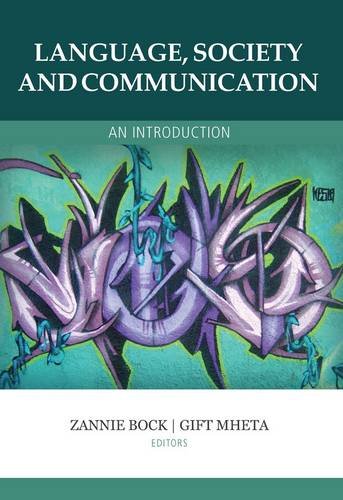
Language, Society and Communication An introduction
Material type: TextSpoken language: English Publication details: Pretoria, South Africa: Van Schaik, ©2014. Description: 564 Pages; Illustrations, 24 cmISBN: 9780627030963DDC classification: 401.9 LANG Summary: Language and Decoloniality in Higher Education brings together a collection of diverse papers that address, from various angles, the issue of decoloniality, language and transformation in higher education. It reflects the authors' cumulative years of experience as educators in higher education in different southern contexts. Distilled as case studies, the authors use a range of decolonial lenses to reflect on questions of knowledge, language and learning, and to build a reflexive praxis of decoloniality through multilingualism. Besides a number of decolonial persepectives which readers will be familiar with, this volume also explores a conceptual framework, Linguistic Citizenship, developed over the past two decades by scholars in southern Africa. In this collection, Linguistic Citizenship is used as a lens to 'think beyond' the inherited colonial matrices of language which have shaped this region (and many other southern contexts) for centuries, and to 're-imagine' multilingualism - and semiotics, more broadly - as a transformative resource in the broader project of social justice. Although each chapter has firm roots in the South African context, these studies have much to offer others in their 'quest for better worlds'. Of particular interest to global scholars are the authors' recounts of how they have grappled with leveraging the country's multilingual resources in the project of promoting academic access and success in the face of historical hierarchies of language and social power"-- Provided by publisher
| Item type | Current library | Collection | Shelving location | Call number | Status | Date due | Barcode |
|---|---|---|---|---|---|---|---|
 Book
Book
|
Ethandukukhanya Public Library | 400: Language | General Stacks | 401.9 LANG (Browse shelf(Opens below)) | Available | 3322803174690 | |
|
Book
|
Kamhlushwa
Library Hours: Mon-Fri - 07H30 - 16H00 Saturday - 08H00- 13H00 |
400: Language | General Stacks | 401.9 LANG (Browse shelf(Opens below)) | Available | 3322803179256 | |
|
Book
|
KWAMHLANGA PUBLIC LIBRARY
Working hours Monday to Friday Time : 07H45 TO 16H15 Saturday and Sunday closed |
400: Language | General Stacks | 401.9 LANG (Browse shelf(Opens below)) | Available | 33228031059626 |
Browsing KWAMHLANGA REGIONAL LIBRARY shelves, Shelving location: General Stacks, Collection: 400: Language Close shelf browser (Hides shelf browser)

|

|

|

|

|

|

|
||
| 400 BEYL Naa Thutlwa e kgona go latswa tsebe ya yona ?/ | 400 HOLD English Sentence Dictionary | 400 LECT Indaba kaMark : umntwana ophila nommulwana weHIV. / | 401.9 LANG Language, Society and Communication An introduction | 425 STRU THE COMPLETE GRAMMAR / | 425 USBO Improve your Grammar | 428 CLAR English home language / |
Include Index
Language and Decoloniality in Higher Education brings together a collection of diverse papers that address, from various angles, the issue of decoloniality, language and transformation in higher education. It reflects the authors' cumulative years of experience as educators in higher education in different southern contexts. Distilled as case studies, the authors use a range of decolonial lenses to reflect on questions of knowledge, language and learning, and to build a reflexive praxis of decoloniality through multilingualism. Besides a number of decolonial persepectives which readers will be familiar with, this volume also explores a conceptual framework, Linguistic Citizenship, developed over the past two decades by scholars in southern Africa. In this collection, Linguistic Citizenship is used as a lens to 'think beyond' the inherited colonial matrices of language which have shaped this region (and many other southern contexts) for centuries, and to 're-imagine' multilingualism - and semiotics, more broadly - as a transformative resource in the broader project of social justice. Although each chapter has firm roots in the South African context, these studies have much to offer others in their 'quest for better worlds'. Of particular interest to global scholars are the authors' recounts of how they have grappled with leveraging the country's multilingual resources in the project of promoting academic access and success in the face of historical hierarchies of language and social power"-- Provided by publisher
Adult
English
There are no comments on this title.