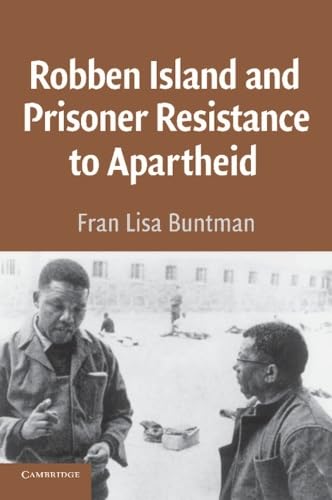
Robben Island and prisoner resistance to apartheid Fran Lisa Buntman.
Material type: TextSeries: Cambridge Africa collection Cambridge Africa collection ; 9780521 007825Publication details: Cambridge, UK ; New York : Cambridge University Press, 2003. Description: xviii, 340 pages colour illustrations: 24 cmISBN: 9780521 007825Subject(s): South Africa | | DDC classification: 323.0440968 BUNT Summary: Summary: "Robben Island prison in South Africa held thousands of black opponents of apartheid, including Nelson Mandela. This book reconstructs these political prisoners' resistance strategies to show how these men created a political and social order behind bars. Survival was their first goal; challenging apartheid was their true aim. So although Robben Island was designed to repress, it was continually transformed by its political inmates into a site of resistance. The book theorizes that, where material conditions permit, the most far-reaching and effective forms of resistance involve constructive political action that seeks to remake existing power relationships. This theory is demonstrated in three focuses of the book: the activism of Robben Islanders, the effects of political prisoner resistance on the apartheid state machinery, and comparative cases that illustrate various international instances of political prisoners' shaping both prisons and political orders."--Jacket
| Item type | Current library | Collection | Shelving location | Call number | Status | Date due | Barcode |
|---|---|---|---|---|---|---|---|
 Book
Book
|
Mkhuhlu | 300: Social Science | Non Fiction | 323.0440968 BUNT (Browse shelf(Opens below)) | Available | 33228 022895187 |
Includes bibliographical references (pages 313-327) and index.
Summary: "Robben Island prison in South Africa held thousands of black opponents of apartheid, including Nelson Mandela. This book reconstructs these political prisoners' resistance strategies to show how these men created a political and social order behind bars. Survival was their first goal; challenging apartheid was their true aim. So although Robben Island was designed to repress, it was continually transformed by its political inmates into a site of resistance. The book theorizes that, where material conditions permit, the most far-reaching and effective forms of resistance involve constructive political action that seeks to remake existing power relationships. This theory is demonstrated in three focuses of the book: the activism of Robben Islanders, the effects of political prisoner resistance on the apartheid state machinery, and comparative cases that illustrate various international instances of political prisoners' shaping both prisons and political orders."--Jacket
Adult
There are no comments on this title.